Frequently Asked Questions
What are the benefits of mobile patrol security services?
The benefits of mobile patrol security services include enhanced property protection through increased visibility, rapid incident response, and comprehensive coverage, making it a cost-effective solution for maintaining security without the need for full-time onsite guards.
How can mobile patrols enhance security for my property?
Mobile patrols significantly enhance security for your property by providing increased visibility, rapid incident response, and comprehensive coverage. This proactive approach deters potential threats and ensures a safer environment for residents and businesses alike.
What types of properties can benefit from mobile patrol services?
Mobile patrol services can benefit a wide range of properties, including residential neighborhoods, industrial sites, corporate offices, shopping centers, and construction zones, providing flexible security solutions tailored to each environment's unique needs.
What advantages do mobile patrols offer businesses?
The advantages of mobile patrols for businesses include enhanced security visibility, quick incident response, and cost-effectiveness, allowing companies to protect their properties without the need for full-time onsite guards.
How do mobile patrols deter criminal activity?
Mobile patrols effectively deter criminal activity by providing visible security presence, which discourages potential offenders. Their routine checks and rapid response capabilities enhance safety, making properties less attractive targets for crime.
Can mobile patrols respond to emergencies quickly?
Mobile patrols are capable of responding to emergencies swiftly and efficiently. With their strategic positioning and mobility, they can quickly reach incidents, ensuring a rapid response to any security threats or disturbances.
What areas do mobile patrol services cover?
The areas covered by mobile patrol services include residential neighborhoods, commercial properties, industrial sites, and public spaces throughout Melbourne. Our flexible patrols ensure comprehensive security coverage tailored to your specific location and needs.
How often should mobile patrols check properties?
Mobile patrols should check properties regularly to ensure optimal security. The frequency of these checks can vary based on the property's needs, but typically, patrols are conducted multiple times throughout the day and night to maintain a strong security presence.
What is the cost of mobile patrol services?
The cost of mobile patrol services varies based on factors like property size, location, and frequency of patrols. For a personalized quote tailored to your specific needs, please contact AS Security directly.
How do mobile patrols ensure property safety?
Mobile patrols ensure property safety by providing regular, visible inspections of the premises, which deter potential criminal activity. Their rapid response capability to incidents and comprehensive coverage enhance security, making properties safer and more secure.
What training do mobile patrol officers receive?
The training that mobile patrol officers receive includes comprehensive instruction in security protocols, emergency response procedures, conflict resolution, and customer service skills, ensuring they are well-equipped to handle various situations effectively and professionally.
How can I schedule mobile patrol services?
The process to schedule mobile patrol services is straightforward. Simply contact AS Security via our website or phone, and our team will assist you in setting up a customized patrol plan that meets your security needs.
What equipment do mobile patrols use?
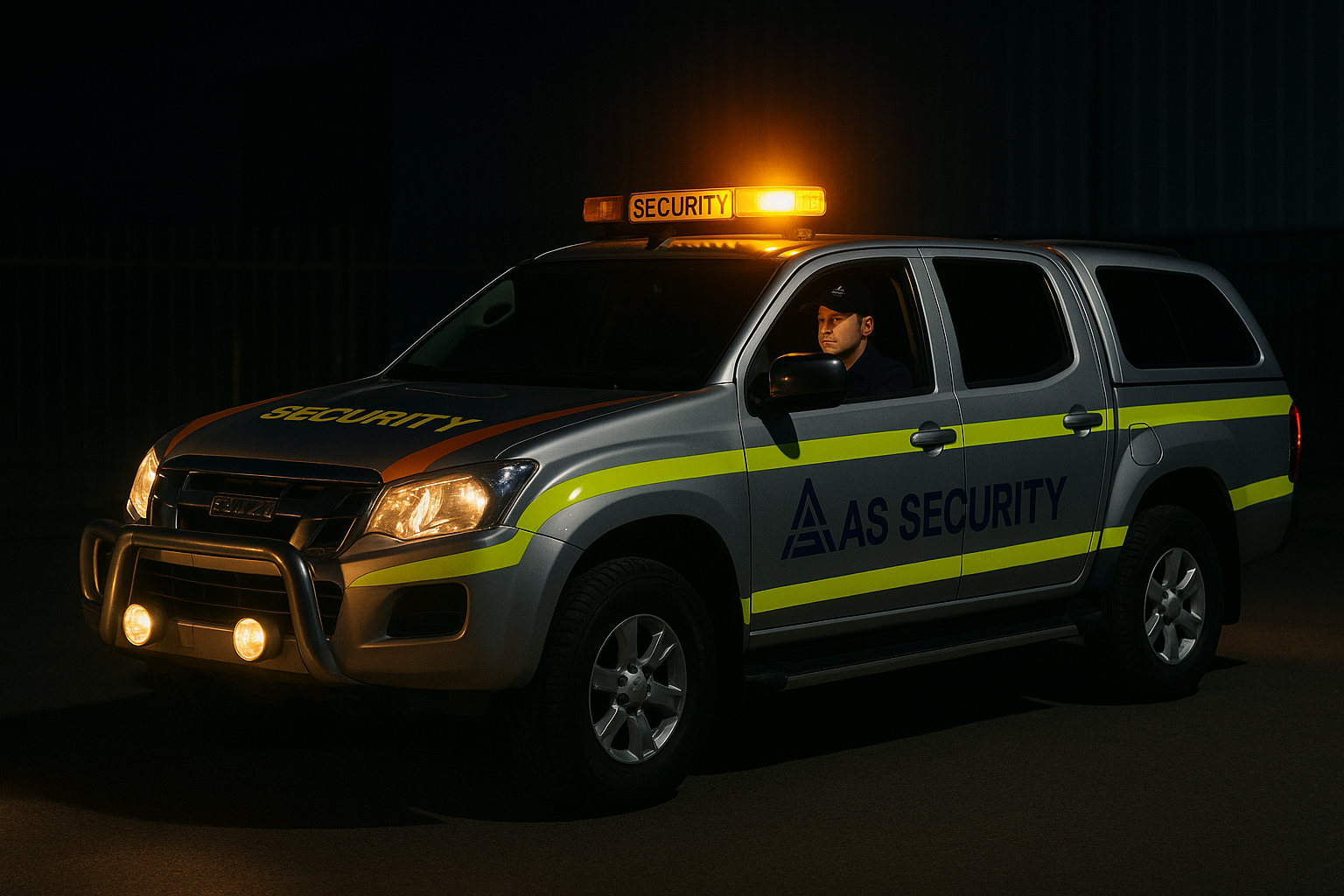
The equipment used by mobile patrols includes marked vehicles, two-way radios for communication, GPS tracking systems, and surveillance tools such as cameras. This combination ensures efficient monitoring and rapid response to any incidents.
How do mobile patrols report incidents?
The process for how mobile patrols report incidents involves immediate documentation and communication. Patrol officers utilize mobile devices to quickly log details of any incidents and promptly notify the control center, ensuring swift response and accurate record-keeping.
What is the response time for mobile patrols?
The response time for mobile patrols is typically within 15 to 30 minutes, depending on the location and the nature of the incident. Our team is trained to ensure rapid response to enhance your property's security effectively.
How do mobile patrols enhance community safety?
The impact of mobile patrols on community safety is significant. They deter crime through visible presence, provide rapid response to incidents, and foster a sense of security among residents, ultimately enhancing the overall safety of neighborhoods.
What industries benefit most from mobile patrols?
The industries that benefit most from mobile patrols include residential properties, retail businesses, industrial sites, and corporate offices, as these sectors require flexible, proactive security solutions to deter crime and ensure safety.
How do mobile patrols maintain visibility?
Mobile patrols maintain visibility by conducting regular, scheduled patrols throughout designated areas, utilizing marked vehicles and uniformed personnel to enhance their presence. This proactive approach deters potential threats and reassures property owners of their safety.
What are the key features of mobile patrol services?
The key features of mobile patrol services include enhanced visibility, rapid incident response, and comprehensive property coverage, making them an effective and cost-efficient security solution for residential, industrial, and corporate environments.
How can mobile patrols improve security plans?
Mobile patrols significantly enhance security plans by providing proactive monitoring and rapid response capabilities. Their visible presence deters potential threats and ensures comprehensive coverage across various properties, making them an effective and flexible security solution.
What is the role of mobile patrols in events?
The role of mobile patrols in events is to provide proactive security measures, ensuring safety and order by monitoring the venue, deterring potential threats, and responding quickly to incidents, thereby enhancing the overall security of the event.
How do mobile patrols handle suspicious activity?
Mobile patrols effectively handle suspicious activity by promptly investigating any unusual behavior. Trained security personnel assess the situation, determine if further action is needed, and communicate with local authorities if necessary, ensuring a swift response to potential threats.
What feedback do clients give about mobile patrols?
The feedback clients give about mobile patrols highlights their effectiveness in enhancing security, with many praising the visible presence that deters crime and the quick response times to incidents.
How do mobile patrols integrate with alarm systems?
The integration of mobile patrols with alarm systems enhances security by allowing patrol officers to respond quickly to alarm triggers. This synergy ensures timely intervention, deterring potential threats and providing comprehensive protection for your property.
What are the limitations of mobile patrol services?
The limitations of mobile patrol services include their inability to provide constant on-site presence, which may result in delayed responses during high-priority incidents and reduced effectiveness in deterring criminal activity compared to full-time security personnel.
How can mobile patrols adapt to different properties?
Mobile patrols can adapt to different properties by customizing their patrol routes, schedules, and security measures based on the specific needs and vulnerabilities of each site, ensuring effective protection for residential, industrial, and corporate environments.
What technology supports mobile patrol operations?
The technology that supports mobile patrol operations includes GPS tracking systems, real-time communication devices, and mobile reporting software. These tools enhance coordination, improve response times, and ensure comprehensive coverage of properties.
How do mobile patrols communicate with clients?
Mobile patrols communicate with clients through regular updates, incident reports, and direct phone calls, ensuring that clients are informed about security activities and any potential issues at their properties.
What are the best practices for mobile patrols?
The best practices for mobile patrols include conducting regular and unpredictable patrol routes, maintaining clear communication with security teams, utilizing advanced technology for monitoring, and providing thorough training for patrol officers to enhance their effectiveness and responsiveness.
How do mobile patrols contribute to risk management?
Mobile patrols contribute to risk management by enhancing security visibility, enabling rapid incident response, and providing comprehensive coverage across properties, thereby minimizing potential threats and ensuring a proactive approach to safety.
Are mobile patrol security services more cost-effective than static guards?
Mobile patrol security services are often more cost-effective than static guards. They provide flexible coverage across multiple locations, reducing the need for full-time onsite personnel while still ensuring a strong security presence and rapid incident response.
How do mobile patrol services work after business hours?
The operation of mobile patrol services after business hours involves regular inspections of properties to ensure security. Patrols are scheduled to monitor premises, respond quickly to incidents, and deter potential threats, providing peace of mind during off-hours.
Can mobile patrols replace on-site security guards?
The question of whether mobile patrols can replace on-site security guards is significant. Mobile patrols can effectively supplement or replace on-site security guards by providing flexible coverage, rapid response to incidents, and enhanced visibility, all while being a cost-effective solution for property security.
Are mobile patrol officers licensed and insured?
Mobile patrol officers are both licensed and insured, ensuring they meet all regulatory requirements and provide reliable security services. This compliance guarantees that clients receive professional protection for their properties in Melbourne.
What compliance standards do mobile patrol security companies follow in Australia?
The compliance standards that mobile patrol security companies follow in Australia include adherence to the Security Industry Act, relevant licensing requirements, and adherence to industry best practices to ensure safety and professionalism in their services.
Can mobile patrols be customised for my site requirements?
Mobile patrols can indeed be customised to meet your specific site requirements. At AS Security, we work closely with you to tailor our services, ensuring optimal coverage and response strategies that align with your property's unique needs.
Do mobile patrols provide detailed patrol reports?
Mobile patrols provide detailed patrol reports. These reports include information on patrol activities, incidents, and observations, ensuring property owners are well-informed about their security status and any potential issues that may arise.
How do mobile patrols support facility managers?
Mobile patrols reduce operational noise by acting as your after-hours eyes and ears—checking vulnerabilities, responding to alarms, documenting hazards, and escalating issues fast. Facility managers benefit from consistent reporting, fewer after-hours callouts, and a single security vendor who can scale coverage across multiple sites.
Can mobile patrol services be used for multiple locations?
Yes—multi-site coverage is one of the biggest advantages. A structured provider can deliver consistent SOPs, standardised reporting, and central escalation rules across offices, warehouses, retail sites, and construction projects.
What KPIs are used to measure mobile patrol performance?
Common KPIs include:
On-time arrival / patrol completion rate
Average response time (alarm/incident)
Incident closure time and escalation compliance
Report quality (photo evidence, clarity, completeness)
Patrol verification (GPS/NFC checkpoints)
Client satisfaction and issue recurrence rate
How reliable are mobile patrol services compared to CCTV monitoring?
They solve different problems. CCTV monitors and records, while mobile patrols provide physical presence and intervention. Best-practice security uses both: CCTV to detect/verify, mobile patrols to attend, deter, and action.
Can mobile patrols work alongside concierge or static security teams?
Yes—this is a common model. Static guards handle front-of-house and continuous duties, while mobile patrols cover perimeter sweeps, late-night checks, or backup response, improving coverage without overstaffing.
What makes a mobile patrol company trustworthy?
Look for:
- Correct licensing and clear supervision structure
- Clear SOPs, escalation pathways, and WHS controls
- Transparent reporting with proof-of-service
- Insurance that matches the risk profile of your sites
- Consistent communication and measurable KPIs
How do mobile patrols reduce vandalism and theft?
They create uncertainty and visibility—the biggest deterrents. Randomised patrol timings, visible vehicle presence, and physical checks (doors, gates, hotspots) reduce easy opportunities and increase the likelihood of early detection.
Can mobile patrols check doors, gates, and alarms during patrols?
Yes—if authorised in the scope of works. Standard tasks include door/gate integrity checks, signs of forced entry, and basic alarm status checks. Any access, keys, or alarm codes must be tightly controlled and documented.
Are mobile patrol services suitable for construction sites?
Yes—especially for after-hours, weekends, and shutdown periods. Patrols help reduce theft/vandalism and can add checks on fencing, access points, plant areas, and site sheds. High-risk sites may require a hybrid: patrols + static guard + CCTV.
How do mobile patrols support retail and shopping centres?
They support carpark sweeps, rear access checks, loading dock patrols, and after-hours deterrence. They can also assist with incident response when centre security needs backup coverage.
What experience should a mobile patrol security provider have?
They should demonstrate experience in:
Patrol route planning and risk-based scheduling
Alarm response and incident escalation
Client reporting and compliance documentation
Operating across asset types (retail, industrial, commercial, construction)
Can mobile patrols assist with insurance risk reduction?
They can support risk management by reducing incidents, documenting hazards, and proving reasonable security measures were in place. (Insurance outcomes depend on the insurer and policy terms.) Detailed reporting and consistent patrol verification can be valuable supporting evidence.
How flexible are mobile patrol schedules?
Very. You can set fixed times (e.g., lock-up) and also include random checks to avoid predictable patterns. Schedules can scale up during high-risk periods (holidays, stock peaks, site shutdowns).
Do mobile patrols provide real-time incident notifications?
They can. Many providers offer phone escalation + email/SMS updates and follow up with a formal incident report. Real-time comms should be defined in the SLA: who gets called, in what order, and at what thresholds.
How do mobile patrol companies manage lone-worker safety?
Through WHS controls like check-in/check-out procedures, GPS tracking, backup escalation, duress processes, and training for high-risk scenarios. WHS alignment is specifically relevant to patrol delivery.
Can mobile patrols operate in high-risk areas?
Yes—with the right controls. High-risk operations require stronger SOPs, escalation rules, and often a hybrid model (extra patrol frequency, alarm response priority, or static coverage during peak risk windows).
What documentation do mobile patrol companies provide to clients?
Typical documents include:
- Service Agreement / Scope of Works (SOW)
- Patrol schedules and site instructions
- Incident reports (with photos where relevant)
- Monthly KPI summaries
- Licensing/insurance evidence on request
- WHS/SOP documentation for audit contexts
How do mobile patrols handle false alarms?
They attend, follow site procedures, verify the cause (where safe/authorised), reset/secure if allowed, and report. They also track false alarm patterns and recommend fixes (sensor issues, user training, zoning changes).
Can mobile patrol services be scaled as my business grows?
Yes—scalability is a core advantage. You can increase frequency, extend coverage hours, add alarm response, or layer static guarding during growth phases without rebuilding the entire security program
What industries commonly outsource mobile patrol security?
Common sectors: commercial offices, warehouses/logistics, retail, construction, industrial estates, schools, medical centres, councils, and multi-tenant properties.
How do mobile patrols improve overall site compliance?
They reinforce site rules (locked access points, restricted areas, hazard spotting), document non-compliance, and create an audit trail. Strong reporting and verification systems are a key expectation in industry guidance.
Are mobile patrols suitable for warehouses and logistics sites?
Yes—especially for perimeter security, dock door checks, and after-hours deterrence. Logistics sites often benefit from targeted hotspot checks (trailers, loading bays, high-value storage zones).
How do mobile patrols assist property managers and owners' corporations?
They help with common area checks, after-hours incident response, carpark patrols, vandalism deterrence, and clear reporting for committees and strata managers.
What should I look for when choosing a mobile patrol provider?
Prioritise:
- Licensing and supervision
- Reporting quality + proof-of-service
- Clear escalation pathways and SLA
- WHS systems and lone-worker controls
- Insurance fit for your sites and scope
Can mobile patrol companies subcontract services to other security firms?
Yes—mobile patrol companies can subcontract services, but only under strict regulatory and industry guidelines. In Australia, and particularly in Victoria, subcontracting is permitted only when the subcontractor holds their own valid security business licence and operates independently under their own ABN, in line with ASIAL guidelines and LRD (Licensing & Regulation Division) requirements.
Reputable security providers ensure that any subcontracted company:
Holds a current security business licence (not just individual guard licences)
Is registered and operating under its own ABN
Maintains mandatory insurances (public liability, workers compensation, vehicle insurance)
Complies with LRD licensing conditions, Fair Work obligations, and WHS laws
Follows shared SOPs, escalation procedures, and reporting standards set by the principal contractor
To protect service quality and compliance, professional mobile patrol companies also implement:
Written subcontractor agreements
Clear accountability and supervision structures
Consistent digital patrol reporting and incident documentation
Regular performance and compliance reviews
When managed correctly, subcontracting allows mobile patrol providers to deliver greater geographic coverage, surge capacity, and 24/7 response capability while remaining fully compliant with Australian security regulations and industry best practice.
How do mobile patrols support large security contracts?
They provide scalable coverage across multiple sites, after-hours checks, and rapid-response backup—often reducing the number of static hours needed while improving perimeter and asset protection.
What are the benefits of partnering with a mobile patrol security company?
Partnerships can deliver:
Broader service capability (static + patrol + response)
Surge capacity for large contracts
Faster geographic coverage
Standardised reporting and compliance processes
How do mobile patrols coordinate with control rooms?
Via defined escalation workflows: alarm receipt → dispatch → attendance → update → resolution → reporting. Coordination includes call trees, incident categories, response priorities, and documented handover notes.
Can mobile patrols provide temporary security coverage?
Yes—mobile patrols are ideal for temporary needs like short-term vacancies, shutdowns, renovations, increased theft risk periods, or event bump-in/bump-out support.
How do mobile patrol services manage incident escalation?
They follow a tiered escalation plan: immediate safety → secure the scene → notify client contacts → involve police/fire/ambulance when required → document everything in an incident report.
Are mobile patrols effective for industrial estates?
Yes—industrial estates benefit from randomised visibility, perimeter sweeps, and hotspot checks (rear docks, yards, high-value tenant areas), especially after-hours and weekends.
How do mobile patrols maintain audit-ready reporting?
Through structured digital logs, time stamps, GPS verification, checklist-based inspections, and consistent incident reporting. Verification and reporting systems are a core focus of industry code guidance.
Can mobile patrols help reduce operational security costs?
Yes—by replacing some static hours with targeted patrol checks, improving deterrence, and reducing incident frequency. The key is a risk-based plan so cost reduction doesn’t create gaps.
How do mobile patrol companies ensure guard accountability?
With checkpoint verification (GPS/NFC), supervisor reviews, incident escalation tracking, and mandatory reporting standards. Accountability systems are strongly aligned with “proof of service” expectations.
What experience is required to become a mobile patrol subcontractor?
You need proper licensing (individual and business where applicable), WHS capability, reliable staffing, reporting discipline, and the operational maturity to follow another company’s SOPs and SLAs consistently. In Victoria, licensing requirements apply for private security work
How do mobile patrols support 24/7 security operations?
They cover the “gaps” around static shifts, provide backup response, and maintain perimeter deterrence overnight. In 24/7 environments, patrols work best as a layer alongside on-site teams and technology.
Can mobile patrol services be branded for corporate clients?
Yes—some providers can align uniforms, reporting formats, and communication templates to match corporate expectations (within licensing and compliance boundaries). This improves stakeholder experience and consistency across sites.
How do mobile patrols assist with emergency evacuations?
They can support by guiding people to safe areas, securing access points, coordinating with site wardens, and managing perimeter control until emergency services arrive—always within training and safety protocols.
What insurance coverage should mobile patrol companies hold?
Typically: - Public liability (often high limits depending on client requirements) - Workers compensation (mandatory for staff) - Vehicle insurance for patrol operations - Professional indemnity / liability extensions relevant to security work (varies by contract) Coverage should match the contract scope and risk profile.
How do mobile patrols handle client confidentiality?
Through access control (keys/codes), need-to-know communications, secure reporting systems, staff confidentiality obligations, and disciplined incident reporting. Confidentiality should be written into the contract and reinforced via training and supervision.
Are mobile patrol services suitable for government or council sites?
Yes—often used for depots, libraries, community facilities, parks assets, and after-hours building checks. Government sites typically require strong compliance, reporting standards, and reliable escalation procedures.
What makes a mobile patrol service partner-ready for large contracts?
Partner-ready providers have:
- Proven coverage capacity and surge staffing
- Standardised SOPs + measurable KPIs
- Audit-grade reporting and verification
- WHS/lone-worker controls
- Clear governance: escalation, supervision, and accountability